
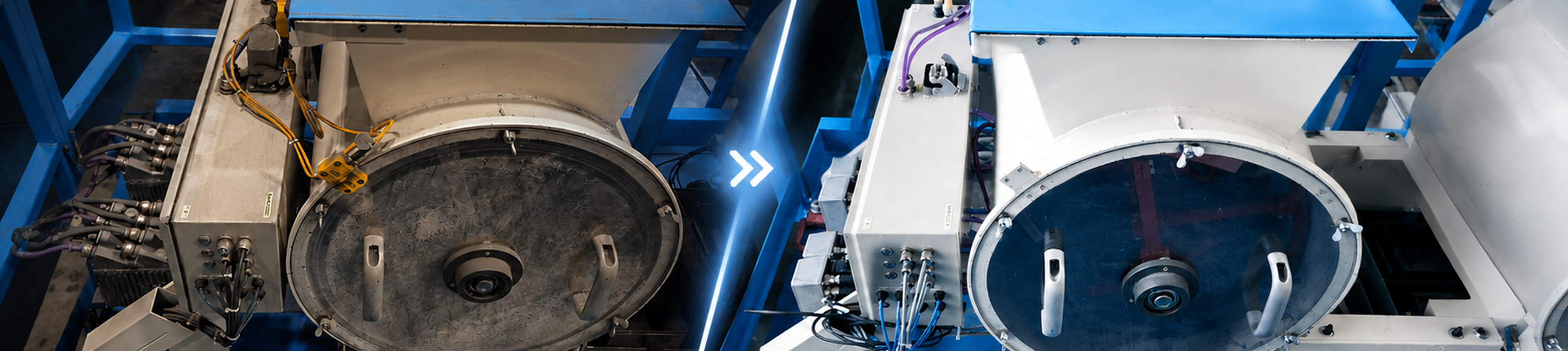
Rethinking Retrofit in Mechanical Engineering
How IAG Unlocks More Potential from Existing Equipment
“Do we really need to invest in new machinery – or can we get more out of what we already have?”
This is a question many companies are asking themselves today.
Rising investment costs, long delivery times, and increasing demands for efficiency and digitalization are putting growing pressure on existing production equipment. At the same time, practical experience shows that many machines still hold far more potential than is immediately visible.
This is exactly where retrofit comes in – not only as modernization, but as a strategic approach to rethinking existing equipment and unlocking its full potential.
In this interview, Philipp Schmidt, Head of After Sales at IAG, explains what truly matters in retrofit projects from a practical perspective.
Interviewer: Mr. Schmidt, why is retrofit currently such an important topic for many companies?
Philipp Schmidt: Many systems are mechanically in perfectly good condition – but technologically they are no longer up to date. At the same time, the requirements for availability, efficiency, and digitalization continue to increase.
Retrofit is often the most sensible solution because it allows us to get significantly more out of existing equipment – without the investment and complexity of a completely new system. Another important factor is speed: retrofit solutions can often be implemented much faster and more flexibly than a complete new investment. Especially when delivery times for new machines are long, companies remain capable of acting and can modernize specifically where the greatest benefit can be achieved.
Interviewer: What risks arise when companies postpone retrofit projects for too long?
Philipp Schmidt: This is often underestimated. One key risk is spare parts availability – especially with older control systems, where sourcing components eventually becomes difficult or expensive. In addition, there are unplanned downtimes and increasing maintenance efforts. And the longer companies wait, the greater the pressure to act usually becomes – which makes projects more complex and less predictable.
From our perspective, it makes sense to modernize early and systematically instead of only reacting once the situation becomes critical.
Interviewer: What are the typical challenges you repeatedly encounter in retrofit projects?
Philipp Schmidt: One thing we repeatedly see is that retrofit is never just a technical topic.
In addition to technology, processes and know-how also play a major role. Due to staff turnover, valuable knowledge about systems is often lost, while structures that have evolved over many years also need to be considered during the project.
Interviewer: What role does training play in this context?
Philipp Schmidt: A very important one. A retrofit is only truly successful if employees are also able to use the system optimally afterwards. That is why we specifically focus on training – and especially on repetition. In practice, a one-time training session is often not enough.
Our goal is to ensure that the know-how is sustainably anchored within the operating team.
Interviewer: How does IAG generally approach a retrofit project?
Philipp Schmidt: We always start with a clear definition of objectives: What does the customer want to improve?This is followed by a structured assessment of the current situation. Especially with older systems, this is essential because machines have often been adapted over the years.
For us, retrofit also means rethinking the system as a whole – technically, in terms of production processes, and in interaction with the employees. Based on this, we develop a solution that is technically sound while also fitting seamlessly into the existing production environment.
Interviewer: Downtime is often a critical factor. How do you solve this?
Philipp Schmidt: For many customers, this is the decisive point. Our goal is to minimize the impact on production as much as possible.
This is achieved through good preparation – for example through prefabrication and testing – as well as implementation within clearly defined time windows or in several stages. Particularly important here is the detailed coordination with the customer: we clarify at an early stage which work can be prepared in advance, which steps are necessary on-site, and how the tasks can ideally be divided. This allows the implementation to be integrated into the production schedule in the best possible way.
Similar principles also apply to machine relocations and production line transfers, where detailed system knowledge and structured recommissioning are essential to minimizing downtime and avoiding unnecessary troubleshooting.
Interviewer: What opportunities does retrofit offer beyond pure modernization?
Philipp Schmidt: Retrofit is often the first step toward digitalization. It creates the foundation for data transparency, improved analysis, and topics such as predictive maintenance. For many companies, this represents real added value.
In addition, retrofit offers the opportunity to continuously adapt existing machines to new market requirements throughout their long machine lifecycle. Product sizes change, pressing technologies continue to evolve, and production requirements become more complex. Through targeted retrofits, existing IAG systems can be aligned with these new requirements – and continue to contribute reliably to value creation.
Interviewer: Your personal conclusion?
Philipp Schmidt: Today, many systems are operated below their actual potential.
With a well-thought-out retrofit, we unlock exactly this potential – while simultaneously preparing systems for the future. This is precisely how we support our customers at IAG – from analysis and implementation to long-term support beyond the project itself.
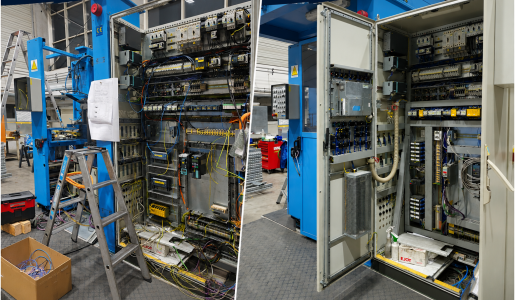
Retrofit of Existing Systems
Modernizing and sustainably optimizing existing systems.


Interviewpartner: Philipp Schmidt, Head of After Sales bei IAG
Responsible for the After Sales division at IAG – from service and maintenance to retrofit projects.